
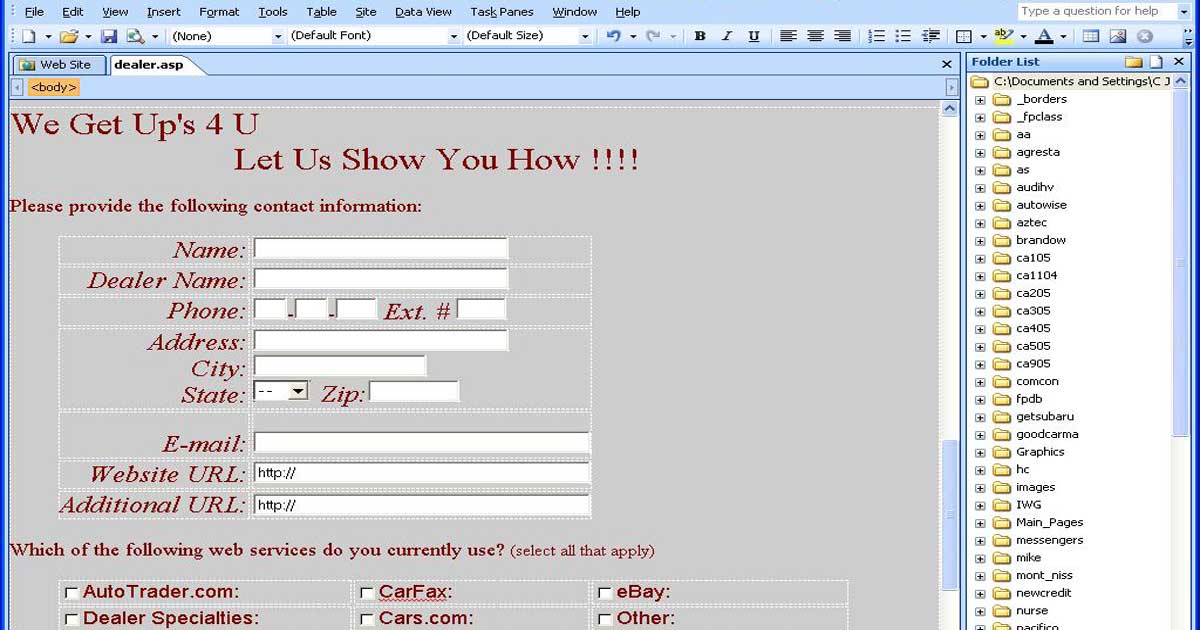
Today if you need a client login system you pick a platform, configure it, and move on. There are dozens of options and most of them take an afternoon to set up. In 2001 that was not how it worked. If you needed a login system you built it. All of it.
This is a look at what dealer login systems actually involved in the early 2000s, what problem they were solving, and what eventually replaced them.
The Problem They Solved
Car dealers working with WebGraphicsRus needed a way to access their own information without calling to ask for it. Inventory status, listing details, credit application submissions, account information. That data existed on the server. Getting it to the right dealer without exposing it to everyone else required a login system.
Simple enough as a concept. The execution was another matter.
There were no plug and play solutions for this. No WordPress user roles, no SaaS dashboard, no API to connect to. You were starting from a blank ASP file and building everything the system needed to function — the login form, the session handling, the database queries, the access controls, the logout, and the error handling for when something went wrong.
Every piece of it was written by hand.
How It Actually Worked
The basic flow was straightforward. A dealer visited a login page and entered their credentials. The server checked those credentials against a database record. If they matched, a session variable was set that identified who was logged in. Every subsequent page checked for that session variable before displaying anything. If it was missing or expired the user got sent back to the login page.
ASP handled session management natively which made that part manageable. The database behind it was typically Microsoft Access for smaller setups or SQL Server for anything that needed to handle more volume. The connection was handled through ADO — ActiveX Data Objects — which was the standard way to talk to a database from ASP at the time.
Password storage was simpler than it should have been by today’s standards. Hashing was not always part of the picture in early implementations. That was common practice at the time and is worth noting honestly when looking back at it.
What the Dealer Actually Saw
On the dealer side it was a clean, simple interface. They logged in and saw their information. Inventory they had listed, applications that had come in, account details. Nothing complicated. The goal was always function over form — get the right information to the right person without confusion.
Dealers were not technical users. The interface had to be self-explanatory. If something required a phone call to figure out it was not built right.
What Replaced It
The dealer management systems that emerged from larger vendors absorbed these functions as the market consolidated. AutoTrader, Cars.com, and the DMS platforms that dealerships adopted came with their own login systems, their own dashboards, and their own ecosystems. The need for a custom-built independent solution largely disappeared.
What replaced the custom login was a vendor relationship. Dealers traded flexibility for convenience and in most cases that was the right trade. A platform maintained by a large vendor is more reliable than a one-person custom build, and by the mid-2000s the platforms had matured enough to make the comparison easy.
Why It Still Matters
Building a login system from scratch teaches you things that using a platform does not. You understand what a session actually is. You understand what happens when authentication fails and why the error message matters. You understand the gap between what a user sees and what the server is doing behind it.
Those fundamentals do not change even when the tools do. The developers who built things from scratch in that era came out of it with a kind of working knowledge that is harder to develop when the platform handles everything for you.
Internal links: How WebGraphicsRus Began — When ASP Was the Answer — The Dynamic Description Creator