
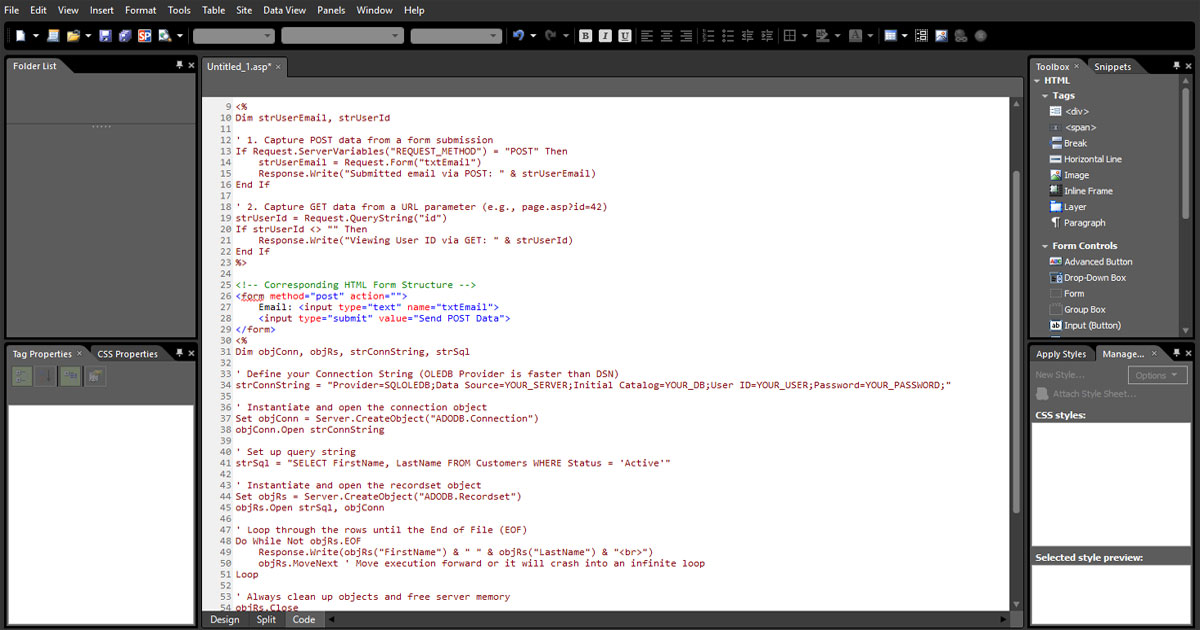
There was a period in the early 2000s when Active Server Pages was the answer to a lot of web development questions. Not because it was perfect but because it worked, it was available, and it got the job done on the hardware and hosting that most people were actually running.
This is a look back at what ASP actually was, why it made sense for the kind of dealer tools being built here, and why it eventually became a dead end.
What ASP Actually Did
Active Server Pages was Microsoft’s server-side scripting technology. You wrote code — typically in VBScript — that ran on the web server before the page was sent to the browser. The browser never saw the code. It only saw the finished HTML that the server produced.
That sounds simple because it is. But in 2001 it was a meaningful step forward from purely static HTML pages. It meant a page could pull information from a database, respond to a form submission, check a login, and serve different content to different users. All of that happened on the server.
For a small operation building practical tools for car dealers, that was exactly what was needed.
Why It Fit the Work
The dealer tools built through WebGraphicsRus were not complicated by modern standards. Login systems, vehicle listing pages, credit application forms, description generators. But they all had one thing in common — they needed to do something. They could not just sit there as a static page.
ASP on a Windows host with a SQL Server or Access database behind it handled all of that reliably. The hosting was affordable. The technology matched what the tools required. VBScript was straightforward enough that someone self-teaching could get productive quickly without a computer science background.
It was the right tool for the moment.
Where It Started Showing Its Age
ASP had limits that became more obvious as the web matured. It was tightly tied to Windows hosting, which meant you were locked into Microsoft’s ecosystem whether you liked it or not. It did not scale gracefully. The code structure encouraged mixing business logic and presentation in ways that became hard to maintain as projects grew.
PHP was gaining ground on Linux hosting that cost less and performed comparably. ASP.NET eventually replaced classic ASP within Microsoft’s own roadmap, but by then the window for small independent developers building on the classic stack had mostly closed.
Microsoft officially ended mainstream support for classic ASP years ago. Most Windows hosts quietly dropped it or stopped recommending it. The sites and tools built on it either got migrated or went dark.
What It Left Behind
The skills built working in ASP transferred. Understanding how server-side code works, how a database connects to a web page, how a session keeps a user logged in — none of that knowledge disappeared when ASP did. The concepts moved forward into other languages and frameworks even if the syntax did not.
A lot of the files built in that era were recovered from old hardware and are documented elsewhere on this site. Some of them still open cleanly. Reading through old ASP files is a strange experience — the logic holds up even when the technology around it has been gone for years.
Internal links: How WebGraphicsRus Began – Dealer Login Systems Before the Cloud – The Dynamic Description Creator