
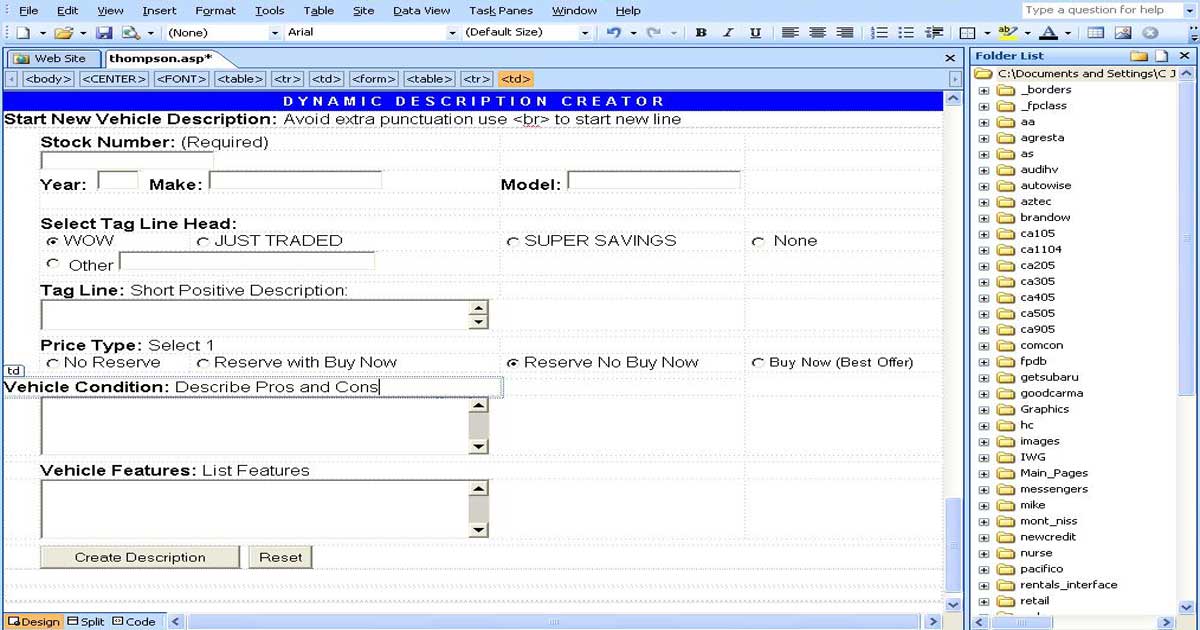
The Dynamic Description Creator was not a complicated idea. It was a practical one. Anyone who has ever had to write individual descriptions for a lot full of cars understands the problem it was built to solve.
The Problem
A car dealer with fifty vehicles in inventory needs fifty descriptions. Each one needs to cover the basics — year, make, model, trim, mileage, condition, key features. Each one needs to sound reasonably consistent and professional. And each one needs to be done before the listings go live.
Doing that by hand is tedious. It is also inconsistent. The first few descriptions come out fine. By the time you are writing the thirtieth one the quality has dropped, details get missed, and the listings start looking like they were put together in a hurry. Because they were.
Dealers did not have time to write copy. That was not their job. Moving cars was their job. The descriptions were something that had to get done but nobody wanted to spend the day on.
What the DDC Did
The Dynamic Description Creator was a form-based tool built in ASP. A dealer or their staff entered the vehicle details — year, make, model, mileage, color, transmission, key options — and the tool assembled a clean, structured description from those inputs.
The output was consistent every time. Same format, same structure, same professional tone regardless of who was filling in the form or how many vehicles they were processing. A dealer could run through an entire lot in a fraction of the time it would take to write descriptions manually.
The descriptions could be copied directly into a listing. No cleanup, no reformatting. Fill in the fields, generate the description, move on to the next vehicle.
Why It Had to Be Built from Scratch
There was nothing off the shelf that did this in 2001. The concept of a content generation tool was not new but purpose-built tools for automotive listings at the independent dealer level simply did not exist in an accessible form. The large dealer management systems had their own solutions but those were expensive, required vendor relationships, and were not available to smaller independent operations.
Building it from scratch meant it could be tailored exactly to how dealers actually worked. The fields matched the information they already had. The output matched the format the listing sites expected. Nothing extra, nothing missing.
That is the advantage of a custom tool. It solves the specific problem in front of you without making you fit your workflow around someone else’s assumptions.
What Happened to It
As listing platforms matured they built description tools of their own. AutoTrader and similar services eventually offered templated descriptions as part of their listing process. AI-generated vehicle descriptions are now common across the industry. What the DDC did manually with form inputs and string assembly is now done automatically with machine learning models trained on millions of listings.
The tool is retired. The problem it solved is still being solved, just with technology that would have been unimaginable in 2001.
What It Represents
The DDC is a good example of what independent web development looked like in that era. You identified a specific problem, figured out the simplest reliable way to solve it, and built the tool. No framework, no platform, no vendor. Just a form, some logic, and an output that worked.
That approach is not glamorous. It does not make for an impressive portfolio piece by modern standards. But it solved a real problem for real people and that is what the work was always about.
Internal links: How WebGraphicsRus Began — When ASP Was the Answer — Dealer Login Systems Before the Cloud