
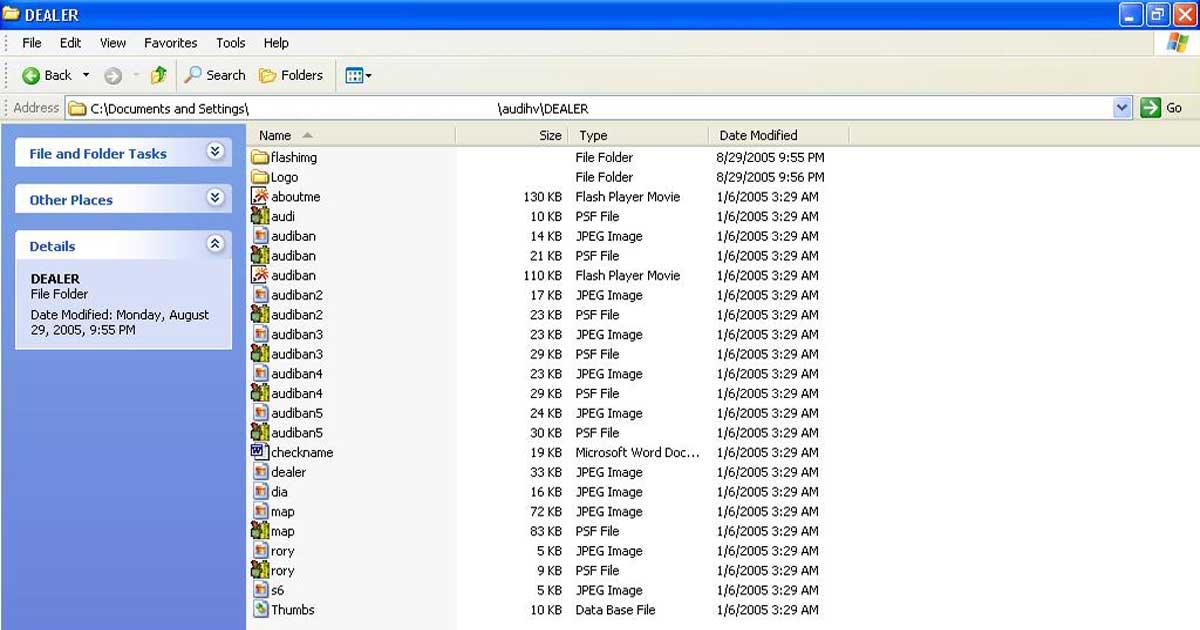
There is a Dell workstation sitting in my office that has not been a primary machine in a very long time. At some point it stopped being the computer I worked on every day and became the computer I kept meaning to deal with. It sat. Years passed. Decades, actually.
When I started rebuilding these archive sites the question of what was recoverable from that machine became relevant again. The answer turned out to be more than expected.
What Was on It
The machine dates to the early 2000s. It ran Windows XP. It was the primary development machine for WebGraphicsRus work during the years when the dealer tools were being built and maintained. That meant it had source files, client folders, project files, and assets that existed nowhere else.
The folder structure alone told a story. Client names I had not thought about in years. Project folders organized the way I organized things back then. Files named in a way that made sense at the time and requires some translation now.
What was there: ASP source files, FLA files from Flash projects, graphics, HTML templates, database files, and documentation written in the moment that reads like notes to a future self who would eventually need to make sense of it all.
What Survived and What Did Not
Text-based files held up almost perfectly. ASP files, HTML, CSS, plain text documents — open them today and they are exactly what they were. The format is simple enough that nothing about it degraded. A .asp file from 2001 opens in any text editor without complaint.
The Flash FLA files are a different situation. The files themselves are intact. Opening them requires software that Adobe no longer supports and that most modern machines do not have installed. Fortunately there is still an older machine available with Flash 5 installed. That is how the screenshots you see on this site were captured — the actual original software opening the actual original files.
Database files varied. Access databases from that era are generally still readable if you have a version of Office that supports the older format. Some required a bit of work to open cleanly.
Graphics and images came through fine. JPG and GIF files from 2001 open without issue in anything. The web was not using exotic formats in those days.
What did not survive as well were the compiled files and anything that depended on a specific server environment to function. An ASP file that pulled from a database cannot run without the server stack it was built for. You can read the code but you cannot run it without rebuilding the environment it expected.
The Process of Going Through It
Going through old project folders is not a purely technical exercise. You remember the clients. You remember the problems you were trying to solve. You find things you forgot you built and things you remember building that you cannot find anywhere.
The Audi of Huntingdon Valley Flash file was in there. The Babylon Business Campus animation was in there. The Dynamic Description Creator source was in there. Dealer client folders going back to the earliest WebGraphicsRus work, organized the way a one-person operation organizes things when they are moving fast and expecting to remember the context later.
Some of it needed no explanation. Some of it required sitting with it for a few minutes before the memory came back.
Why It Was Worth Doing
Recovering these files was not about making the old tools functional again. That ship has sailed. It was about documentation — having the actual source material to point to when writing about what was built and how it worked.
The screenshots on this site are not reconstructions. They are the original files open in the original software on hardware that predates most of what people use today. That is worth something when the goal is an honest archive rather than a polished retrospective.
If you have old hardware sitting somewhere with work on it from an earlier period of your life, it is worth finding out what is still there before the machine stops being recoverable. Hard drives do not last forever. The files that seem unimportant now may be the ones you wish you had later.
A Note on the Hardware
The Dell workstation is still running. Slowly, but running. At some point it will not be, and when that happens anything that has not been copied off it will be gone. That is the other lesson from this process. Recovery is only possible while there is still something to recover.
Internal links: How WebGraphicsRus Began — When ASP Was the Answer — Flash Was Not a Gimmick — The Dynamic Description Creator